


Mystery lovers: sorry if you've returned to this blog lately and been disappointed with the lack of new reviews. I promise they'll start again very soon.
Here's my excuse: Once a year, I try to read a non-mystery, just because I feel like I ought to. This year's choice is Hilary Mantel's Wolf Hall. It's the story of Henry VIII's dumping his first wife in order to marry Anne Boleyn. I'm finding it really slow going. Mantel uses far too many pronouns, when a proper noun or two would make her story clearer. Her text is so dense that I find it hard to wade through. Often, she'll have a long paragraph about the weather or scenery, and end with a sentence that is crucial to the plot. Mystery writers know how to showcase those important sentences so that we rarely miss them.
I feel very self-righteous for reading it, and that's worth a lot! But it's slow going, and is keeping me from blogging. I generally knock off a mystery in about three days, while Mantel's historical novel has taken me over two weeks. What this annual exercise always shows me is how much I love mysteries. I never tire of them.
But I'm almost done, and then it's back to the good stuff! Thanks for sticking with me. I'll be back soon.
Tuesday, September 18, 2012


Friday, September 7, 2012
The Exceptions, by David Cristofano (Grand Central Publishing; $24.99)
The Bovaro family’s mantra is no loose ends. One of the most powerful mob families in New York, they know that
much of their influence comes from their enemies knowing that the family will
ultimately get their revenge, no matter how long it takes.
When the McCartney family of Montclair, New Jersey,
decided to go out for an early breakfast, they had no idea that it would change
their life. Mom, Dad, and pretty little Melody entered Vincent’s restaurant in
New York’s Little Italy just in time to see Tony Bovaro slit the throat of
Jimmy “the Rat” Fratello. The McCartneys drove off, but not before 10-year-old
John Bovaro caught sight of their license plate number. John was captivated by
the little girl, so when the cops came, he asked them if they knew whether the
girl was alright. That tipped the cops that there were witnesses; they found
the McCartneys and put them in the witness protection program. Mom and Dad
testified at the trial, the case was thrown out, and killing the McCartneys—all
three of them—became the Bovaro family mission.
Fast forward some 20 years. John Bovaro—now Jonathan—has
gone almost respectable. He owns a trendy New York restaurant, although his family
uses the place to launder money. Assigned by his family the task of killing Melody McCartney,
he has a Justice Department employee with a gambling addiction on his payroll,
providing Melody’s current identity and address in exchange for debts being
covered. Jonathan hunts Melody down wherever she is, telling his family he’s
planning to do the hit, while telling himself that he’s protecting her.
And here’s where the book got creepy. Under the guise of some weird unrequited love
for Melody, Jonathan became her stalker. He decided he would become “Man in
Produce Section and Stranger on Cell Phone and Jogger in Park” in order to keep
an eye on her. He finally makes contact and lets her know how long he’s been
watching her—decades, at this point. It wasn’t the tragic Mob version of the Capulets and Montagues that I
think Christofano wanted to portray. Instead, this was just sick. Had I been
Melody, I would have run as fast as I could the other way, although admittedly,
her options were limited. But I really, really didn’t like Jonathan. His
behavior gave me the jim-jams even when he was trying to seem normal and heartbroken.
The Exceptions
just didn’t do it for me.
Wednesday, August 29, 2012
A Wanted Man, by Lee Child (Delacorte Press; $28.00)
Jack Reacher is an unlikely hero. As he describes himself,
he’s a “No-account, unemployed and homeless veteran. . . with no stable
relationships.” He hitchhikes across the country and, even in this day and age,
still manages to get rides. But the rides always end badly, with Reacher having
to shoot bad guys and foil crime in whatever locale he finds himself.
In A Wanted Man,
Reacher is still—as in Child’s most recent books—trying to get himself to Virginia. He’s fallen
for a woman he’s spoken to on the phone, and wants to meet her in person to see
if there’s the chance of romance. But, as always, his plans are detoured when
his ride doesn’t quite work out. This time, he’s picked up by two guys and a
woman, and the woman tries to signal to Reacher that something is amiss. The
reader knows that earlier that evening, three guys had walked into a bunker but
only two walked out. But where the woman came from, who the dead guy was, and
why the FBI, CIA, and State Department are all involved in what looks to be a local
crime is the crux of the story.
I really like Reacher, though I’ve read so many of Child’s
mysteries that his character’s idiosyncrasies make me roll my eyes. For one
thing, Reacher only owns the clothes on his back, since he has no luggage. So
when they get dirty (three days on a shirt) he merely buys more. He budgets
between $20-$25 a day, which he feels is “cheaper than living somewhere, and
easier than washing and ironing and folding and packing. That was for damn sure.” But where does he
get his money? And if he carries it with him (he doesn’t seem like a credit
card kind of a guy), how does he not get rolled by the occasional bad guy who
picks him up?
Oh—I forgot. He’s Jack Reacher. Who would dare?
He also has an internal clock that should be in a museum. My
mother has pointed out that he always knows what time it is, despite not
wearing a wristwatch. In this book, he sets “the clock in his head for two
hours” to force himself to wake up though he hasn’t slept for at least 24
hours.
But the little tic that I like the most is Reacher’s
emphatic, “That was for damn sure” whenever he mentally agrees with
himself. (I included one of these lines
in the quote in the third paragraph.) I once heard Lee Child speak at a book
festival, and someone pointed out that he writes that line in his books
frequently. The fan asked Child if he uses it so often because he uses it
himself. As I recall (I wasn’t taking notes, and this was several years ago),
Child said that it was more of a writer’s device to transition between scenes
or action. I had never noticed the line prior to hearing the question, but once
it was pointed out, I notice it whenever I read one of his books.
Lee Child’s Jack Reacher stories are improbable, similar,
and totally enjoyable. That’s for damn sure.
Sunday, August 26, 2012
Gone, by Randy Wayne White (Putnam; $25.95)
I’ve always enjoyed Randy Wayne White’s Doc Ford mysteries.
I’m a sucker for mysteries set in Florida,
and his were among the best. So I was excited to learn that he had started a
new series, focusing this time on a young fishing guide/sleuth named Hannah Smith.
The series debut, Gone,
made me laugh out loud—and it wasn’t meant to be funny. Not because of flaws in any of the important
elements. Smith was clever, brave and likeable. The plot was fine: a fabulously
wealthy young woman has disappeared, perhaps in the company of a sadistic
boyfriend, and Hannah is asked to find her and bring her home. And the setting is great: it’s hard to go
wrong when you set a mystery in the the steamy, fetid atmosphere of Florida.
No, what’s wrong with Gone
is that it was written from a woman’s perspective by a man obsessed with
breasts.
Seriously.
The first time I
noticed it was when Hannah, wanting to perk herself up, dresses up and checks
herself out in the mirror. She delights in looking at herself as she "spills out of her favorite
34D bra.” The sight gets makes her get “teary-eyed and smile, because she, in
her own mind, is about as shapely as an ironing board balancing two peas.”
I have yet to meet the woman who gets teary-eyed at the
sight of herself “spilling out” of a bra. The sight might well bring a man to
tears—as a woman, I wouldn’t presume to know. But to a woman? “Spilling out”
just means it’s time to buy a bigger bra.
Several pages later, a gay friend says to her, “’I’ve never
opened a Playboy magazine in my life,
but, I swear, Hannah, even I love
your tits.’”
A bit later, she interviews an older woman who had been
victimized by the guy who may be responsible for the young woman’s
disappearance. She sees “what might have been a Chantelle bra, raspberry lace
and glitter, draped over a velvet divan.” The older woman, who starts out being hostile,
eventually warms to Hannah, pressing a grocery bag on the younger woman as a
gift; inside is the very same bra. “The fact that Mrs. Whitney and I wore the
same bra size—34D—had helped, too. It created a sisterly feeling that is often
the reward when women share private matters they wouldn’t entrust to a man.”
Oh, where to start with this one. First, older women don’t
usually leave their bras out where guests can see them. Second, they never—you
can take this one to the bank—present a used, unwashed bra to another woman as
a gift. Third, the “fact” that the witness and Hannah wore the same bra size
would be unknown to either woman, as women—and this may come as a surprise to
men reading this--don’t exchange that information upon meeting each other. And fourth, sharing the same bra size would
not create a “sisterly feeling.” I’m
still laughing about this one. The only scenario in which I could imagine women
bonding over sharing the same bra size is if they met in a plastic surgeon’s
waiting room prior to augmentation.
(Much, much later, Hannah finds herself in danger and
distracts the bad guy by unbuttoning her third button, “enough for him to see
me spilling out of Mrs. Whitney’s 34 D Chantelle bra.” I’m hoping she at least
laundered Mrs Whitney’s bra before wearing it. But again—spilling out? Clearly,
they don’t wear the same bra size: 34
D may have fit Mrs. Whitney, but Hannah needs to go in for a fitting.)
But wait: there’s more! A lawyer changes into a satin blouse
which reveals “her bouncing breasts when she walked.” Another character has
“grapefruit-sized implants.” The list goes on and on.
Randy Wayne White needs to forsake this experiment and go
back to writing from a guy’s point of view. He can still include nonsense like
this, if he thinks it would help move his plot along. For instance, he could
describe Doc Ford getting “teary-eyed” as he looks at himself in a mirror,
“spilling out” of an athletic supporter that’s too small. Or interviewing a witness,
where he sees dirty boxers thrown over the back of a couch—only to find that
the witness made him a gift of that same pair of dirty boxers. All the while
sharing that brotherly bond that comes when two guys wear the same size
underwear.
Unbelievable.
Randy Wayne White: living up to his first name.

Tuesday, August 14, 2012
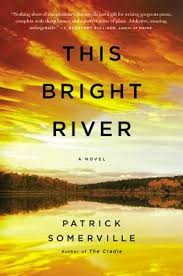
This Bright River, by Patrick Somerville (Reagan Arthur; Little, Brown; $24.99)
Patrick
Somerville sure can write. So well, in fact, that I didn’t even mind—or notice,
for that matter—that nothing much happened in the 450-page This Bright River until the last 100 pages. Actually, just as I was
starting to wonder how I would review the book in a mystery and thriller blog,
a bad guy finally appeared.
Upon his
release from prison, Ben Hanson moves to his late uncle’s house in St. Helens, Wisconsin.
There he tries to woo Lauren Sheehan, a woman he’d known in high school. Ben has a past, obviously, and Lauren does as
well. Ben’s history is more obvious; drug problems led to the arson that landed
him in jail. But Lauren has seen her share of violence, as well, and it makes
wooing her a difficult task indeed.
Living in
his old hometown makes Ben curious about his family. Years earlier, Ben’s
cousin froze to death in the wilds of Wisconsin. The family has always been troubled about the
circumstances of that death. In remembering conversations, searching through
files, and visiting the places of his youth, Ben finally uncovers secrets that
his family would have preferred he not know.
I hate when
people tell me their dreams, and I particularly hate when authors include
dreams in novels. Other people’s dreams
are boring, and when they go on for pages, they are excruciating. This book includes quite a few, and they are
the one flaw in an otherwise spellbinding story. I skipped them in protest, and found that I
could still follow the action with no trouble. Somerville’s descriptions are lyrical, and
his characters were compelling. This is
a beautifully written story.
Sunday, August 12, 2012
Creole Belle, by James Lee Burke (Simon & Schuster; $27.99)
It’s been a
long time since I read one of James Lee Burke’s novels starring Iberia
Sheriff’s Deputy Dave Robicheaux. Creole Belle reminded me why I had quit.
His setting is beautiful, his characters memorable, and his writing elegant.
But his plots, to put it quite bluntly, are a mess. I have always felt that if he could limit
himself to fewer story lines, his books would be so much stronger. This latest
is no different: he’s got a contract killer, a long lost daughter, a Nazi war
criminal, evil oil company execs, extortionists trying to collect on an old
debt, an immoral televangelist, a sadistic artist, a cruel albino (who someone
tries to stuff into a tanning bed), a Creole singer who may or may not be just
a morphine dream, Vietnam memories, a nanny-cam used for nefarious purposes—the
list goes on and on.
Underneath the fictional plot and myriad side plots is a true crime novel: the rape and pillage of the state of Louisiana by oil companies who don’t care about the environment, the people, or the way of life, but who have the support of the people who pay the stiffest price. “Let’s face it,” Burke writes. “It’s hard to sell the virtues of poverty to people who have nothing to eat. In Louisiana, which has the highest rate of illiteracy in the union . . .few people worry about the downside of casinos, drive-through daiquiri windows, tobacco depots, and environmental degradation washing away the southern rim of the state. . .working class people display bumper stickers that read GLOBAL WARMING IS BULLSHIT.
The characters are familiar and charming as ever, although Dave Robicheaux’s praise of his lawyer/novelist daughter, Alafair, comes on a little strong, particularly for anyone who knows that Alafair Burke, Burke’s real-life daughter, is a lawyer/novelist. As always, Clete is my favorite character. In this latest book, the lonely Clete falls in lust—twice. This is an amazing accomplishment for a man who, when one of the women shows up at his house, describes himself by saying, “I’m an awkward guy. I have a way of messing up things. I’ve got a bad track record with relationships . . . I’m over the hill. I break the springs in bathroom scales. My doc says there’s enough cholesterol in my system to clog a storm drain. . .I’ve got a sheet longer than most perps’. I capped a federal informant. There are some government guys who’ve got it in for me because I fought on the leftist side in El Salvador.’” (Why do I hear Joe E. Brown saying, “Well, nobody’s perfect!”?!)
No one sees
Creole singer Tee Jolie Melton when she visits Dave Robicheaux, in the hospital
where he’s recovering from being shot. In fact, no one even believes that she
was there at all. But now she’s missing,
along with her younger sister. Clete
Purcel, stalwart sidekick that he is, agrees to help Dave look into her
disappearance. Meanwhile—and this is where it all started to get confusing —some
mopes visit Clete and tell him he still owes money on a debt he paid off years
before. The marker was found in an old safe. Then someone shoots the mopes, and
the shooter might be the Clete’s long-lost daughter. The mopes are somehow
connected to a sadistic artist, the son (and perhaps grandson) of a Holocaust
victim who uses a hateful word to describe Jews. As the plot meanders down each new twist, it
becomes harder and harder to remember what the book is actually about.
Underneath the fictional plot and myriad side plots is a true crime novel: the rape and pillage of the state of Louisiana by oil companies who don’t care about the environment, the people, or the way of life, but who have the support of the people who pay the stiffest price. “Let’s face it,” Burke writes. “It’s hard to sell the virtues of poverty to people who have nothing to eat. In Louisiana, which has the highest rate of illiteracy in the union . . .few people worry about the downside of casinos, drive-through daiquiri windows, tobacco depots, and environmental degradation washing away the southern rim of the state. . .working class people display bumper stickers that read GLOBAL WARMING IS BULLSHIT.
The characters are familiar and charming as ever, although Dave Robicheaux’s praise of his lawyer/novelist daughter, Alafair, comes on a little strong, particularly for anyone who knows that Alafair Burke, Burke’s real-life daughter, is a lawyer/novelist. As always, Clete is my favorite character. In this latest book, the lonely Clete falls in lust—twice. This is an amazing accomplishment for a man who, when one of the women shows up at his house, describes himself by saying, “I’m an awkward guy. I have a way of messing up things. I’ve got a bad track record with relationships . . . I’m over the hill. I break the springs in bathroom scales. My doc says there’s enough cholesterol in my system to clog a storm drain. . .I’ve got a sheet longer than most perps’. I capped a federal informant. There are some government guys who’ve got it in for me because I fought on the leftist side in El Salvador.’” (Why do I hear Joe E. Brown saying, “Well, nobody’s perfect!”?!)
When the
smoke has cleared and the body count totaled, what’s left is Burke’s tribute to
a way of life that no longer exists, one that was leveled by Katrina and
poisoned by the BP spill.

Monday, July 30, 2012
Broken Harbor, by Tana French (Viking; $27.95)
Patrick and Jenny Spain were the perfect couple. High school
sweethearts, they had eyes only for each other. They married, had two perfect
kids, and decided it was time to jump on the real estate band wagon. They paid
too much for a house being built in Brianstown, a housing development on the Irish Sea. It was far from family and friends, but they figured
they could turn it around in a few years.
Then came the recession. Pat lost his job, the builder took
off, Brianstown became a ghost town. And then things went from terrible to devastating.
When Jenny’s sister found the bodies, the super assigned the
case to Detective Mike Kennedy and rookie Richie Curran. Brianstown holds
special meaning for Mike Kennedy. When he was young, his family used to
vacation there, back when it was called Broken Harbor.
But the Kennedys never returned after the summer his mother died.
Kennedy and Curran are puzzled by the Spain’s house. Despite the two kids, it is pristine, with nothing out of place. But someone—or something—has knocked holes in
the walls, there are baby monitors everywhere, and there is a huge, lethal trap
in the attic capable of ensnaring a bear.
In no time, the detectives catch a guy who quickly admits to
killing Pat and the two kids, and critically wounding Jenny. But there’s
something not quite right about his confession. The detectives continue
investigating, trying to tie up the loose ends. What they learn is the sad
story of a family’s dreams ripped apart by forces they never saw coming.
Tana French’s Broken Harbor
is a tense, well-plotted police procedural.
The characters are memorable--each is struggling with loneliness,
disappointment, and all the other emotions that come with realizing that life
hasn’t worked out according to plan. This is a great summer read.

Sunday, July 22, 2012
Lake Country, by Sean Doolittle (Bantam Books; $15.00)
Boy, I like Sean Doolittle. This guy is terrific. His
latest, Lake Country, resulted in two
back-to-back nearly sleepless nights for me. Reading the book before bed got me
so tense that although I forced myself to turn out the light, I was too wound
up to sleep.
So here’s the plot: a young woman is hit head-on by a
wealthy architect who fell asleep at the wheel. The woman’s brother is serving
in Iraq;
two Marines, Darryl Potter and Mike Barlowe, accompany him to headquarters
where he gets the news that his sister has died. As the brother prepares to
leave for the funeral, his truck is hit by an IED and he’s killed.
Potter and Barlowe eventually leave the military, but their adjustment
to civilian life is rocky at best. Potter has had the most trouble: instigating
bar fights, drinking himself unconscious, and working sporadically as a
collector for a bookie. As they sit in their favorite bar watching a TV. news
reporter talk about the fifth anniversary of the death of their buddy’s sister,
Potter rails against the injustice of the architect’s light sentence. Secretly,
he hatches a plan to even the score.
The next day, some goons show up at Potter and Barlowe’s
apartment, looking for Potter and the $11,000 he stole from a restaurant. Barlowe
goes back the bar where they’d been the night before and learns that the
bartender innocently gave Potter permission to use his lake house. When the same TV reporter from the night before reports that the architect’s 20-year-old
daughter is missing, Barlowe realizes his friend is spiraling out of control. He sets out to rescue the girl by finding Potter, with the the goons, cops, and TV reporter hot on his trail.
Doolittle draws memorable, complex characters, all of whom
have been beaten down by life. Even
better than his characters, however, is his superb plotting. My description of
the plot doesn’t do it justice—it flows with a terrific combination of unexpected
twists and bleak inevitability. I can’t
say enough about this author: I like every book of his that’s I’ve read. Lake Country
is one of best books I’ve read in long, long time.

Wednesday, July 18, 2012
Jack 1939, by Francine Mathews (Riverhead Books; $26.95)

I will be the first to admit that I frequently judge a book
by its cover. Sure, I’ll read something with a plain cover, as long as it’s by
an author I already like. But I’m a bit of a sucker for great creative cover
art. So it was no surprise that I was drawn in by the cover of Francine
Mathew’s Jack 1939. The cover photograph, of a very young JFK in
a fedora, with the Eiffel
Tower over his right
shoulder, was one of the best covers I’ve seen in a long while.
The plot of the book is simple: Hitler wants to buy the 1940
US
presidential election in order to put an isolationist in the White House. FDR needs to know who is running Hitler’s
financial network and how the money—some $150 million so far—is
being brought in. He asks Harvard student Jack Kennedy, about
to travel to Europe to research his senior thesis, to serve as his eyes and
ears in Europe. JFK’s cover is enhanced due to
the widely-known enmity between FDR and Joe Kennedy, the US ambassador to England and an avowed isolationist
himself.
The book has all the trappings of a great spy thriller: cruel
Nazis, disappearing ink, beautiful women, rich boys in formal wear, and Europe on the brink of war. The characters are, of
course, familiar, since most are historical figures. Those that aren’t however,
are also familiar, due to Mathews’ reliance on clichés. (Femme fatale who just
might be a German spy; ugly German assassin.)
Mathews’ depiction of JFK, however, is novel. Here he is
nearly incapacitated by a debilitating illness that renders him gaunt and
weak. And he’s not the rake we have come
to know; instead, he loses his heart easily and frequently. He seems to have no
political aspirations of his own, while despising his father’s amoral ambition.
Most fun of all, we see the famous Kennedy family members in a very human
light, such as Rose as a cold social climber and Teddy as an annoying younger
brother.
In the author’s notes, Mathews discusses her research and
says that she put her JFK character in various countries and meeting with
actual figures (such as George Kennan) at the same time that the real JFK
visited those places and people. I can’t begin to know how much of the story is
real and how much is fiction. In the end, it doesn’t really matter: the book is
an exciting thriller in any case.
In her notes, Mathews said that she was drawn to write the
story when she saw a photo of a 22-year-old JFK juggling while at Harvard. If a
photo is enough to persuade her to write a whole novel this fun, I think I was
justified for reading it based solely on the cover!

Monday, July 9, 2012
Niceville, by Carsten Stroud (Knopf; $26.95)
Something is definitely not nice in Niceville. Ten-year-old Rainey
Teague disappeared while walking home from
school one day. It’s not the first missing persons case the town has known. In
fact, the town has a stranger-abduction rate more than five times
that of the rest of the country. Two per year since 1928, to be exact.
Rainey’s disappearance is only one of many, many ugly
occurrences in the pretty little town. The local bank gets robbed, and a sniper
picks off each of the cops chasing the escape car. Along with the bank’s $2.5 million, the
robbers swiped a top-secret piece of equipment previously stolen from a local
Raytheon subsidiary. A prominent citizen films his adolescent
daughters in the shower. And mirrors and windows reflect something
evil.
The sleepy southern town was built against Tallulah’s Wall,
a forbidding-looking cliff that serves as the northern border. Locals think
that the town’s problems might stem from Crater Sink, an ominous, bottomless
sinkhole at the top of the wall. Readers realize early on—far, far earlier than
the characters do, that the true source of the problem is time travel gone seriously
awry.
Carsten Stroud is an amazing talent. His writing is elegant, his setting
fabulously ominous, and his characters refreshingly unique. He describes one couple as being “as frigidly
unappealing as banana-flavored Popsicles.”
About Tin Town, Niceville’s slum, Stroud said,
“the main industry ruling the place was a lethal combination of grinding hard
times, blood-simple gunsels, pointless death, and blue ruin.” (I’m not sure
what “blue ruin” is, but I liked the phrase.) Despite his skill—or rather,
because of it—I ultimately found Niceville
infuriating. The problem? The plot is a
hot mess. There are too many story lines, and Stroud does not bother to weave
them together. Characters are thrown in
the mix in a way that implies they’ll somehow impact the plot; too often, they
have no effect at all. When one character takes action to destroy another, Stroud writes, “the fact that he was, in effect, about
to commit a kind of suicide was not clear to him at the time.” Set-ups of that sort deserve resolution equal
to the drama of the language; the fact that the character was alive and well at
the end of the book left me scratching my head. The supernatural aspect of the plot is not
compelling and the climax of that story line incomprehensible. Stroud is
careless and sloppy. In the mystery world, those are capital crimes.
I couldn’t put this book down, but when it was done, I
wanted to stomp it into dust. It’s a
great read with an outstandingly unsatisfying ending.
Thursday, June 28, 2012
Criminal, by Karin Slaughter (Delacorte Press; $27.00)
1975: What happened
to Kitty, Lucy and Mary? The three young
women have disappeared, and Jane Delray, a fellow hooker, wants the police to
find out. Soon Jane herself is dead, allegedly a suicide. No one seems to care about
any of the missing girls. Not only were they in the life, they were also drug
addicts, and their families had given them up long before.
But Atlanta Police Department detectives Amanda Wagner and
her partner, Evelyn Mitchell, care. In the face of what today seems like
unfathomable prejudice and outright hatred from their fellow cops, the two
women doggedly pursue the case. Despite being ordered to stop by those in a position to scuttle their careers, they don't give up until they've proved they're ever bit as competent as their male counterparts.
Present day: Amanda
Wagner is now a supervisor at the Georgia Bureau of Investigation. A
19-year-old student at Georgia Tech has gone missing. GBI agent Will Trent
recognizes that the missing girl is a dead ringer for his mother, murdered by
his father around the time of Will’s birth.
When Will learns that his father is out on parole, he knows that the
monster has picked up where he left off. But this time, it’s personal, and Will—and
Amanda—will do anything they can to save other girls.
Karin Slaughter always writes good thrillers, and this one
is no exception. The unexpected twists
and turns far outweigh the instances where the reader beats the
investigators in figuring things out.
Sunday, June 24, 2012
Ransom River, by Meg Gardiner (Dutton; $25.95)
After the horrific accident that nearly cost her her life,
Rory Mackenzie hoped to leave Ransom
River, California,
forever. But then the non-profit she worked for lost its funding and she had to
return to the states, where a summons for jury duty awaited her.
The trial should have been somewhat routine: two cops,
having an affair, were fooling around at one of their houses when they were
surprised by an intruder. The female cop fired her weapon, killing the
16-year-old burglar. The dead kid turned out to be the son of Ransom River’s
most notorious criminals.
But the trial turns anything but routine when two masked
gunman manage to bypass the courthouse security system, burst into the
courtroom, and take four hostages. The choice of hostage appears to be random—until
they specifically choose Rory. When the
incident comes to a bloody end, the cops don’t believe Rory when she professes
not to understand why the gunmen wanted her. If she is to clear her name, Rory
must learn what the gunmen thought she knew.
She’s aided in her search by an old friend: Seth Colder,
former cop, former fiancé. Seth was the reason Rory left Ransom River,
and he’s the last person she wants to go to for help. Seth knows the town’s
secrets, and he suspects there is corruption among the police. But he doesn't know the Mackenzie family's secrets, and how intricately those secrets are connected to an unsolved robbery
committed years earlier.
Best known for her Jo Beckett and Evan Delaney mystery
series, Meg Gardiner’s Ransom
River shows she can
handle a stand-alone mystery as well. This was a compelling summer read.
Subscribe to:
Posts (Atom)